
Original: $49.00
-65%$49.00
$17.15The Story
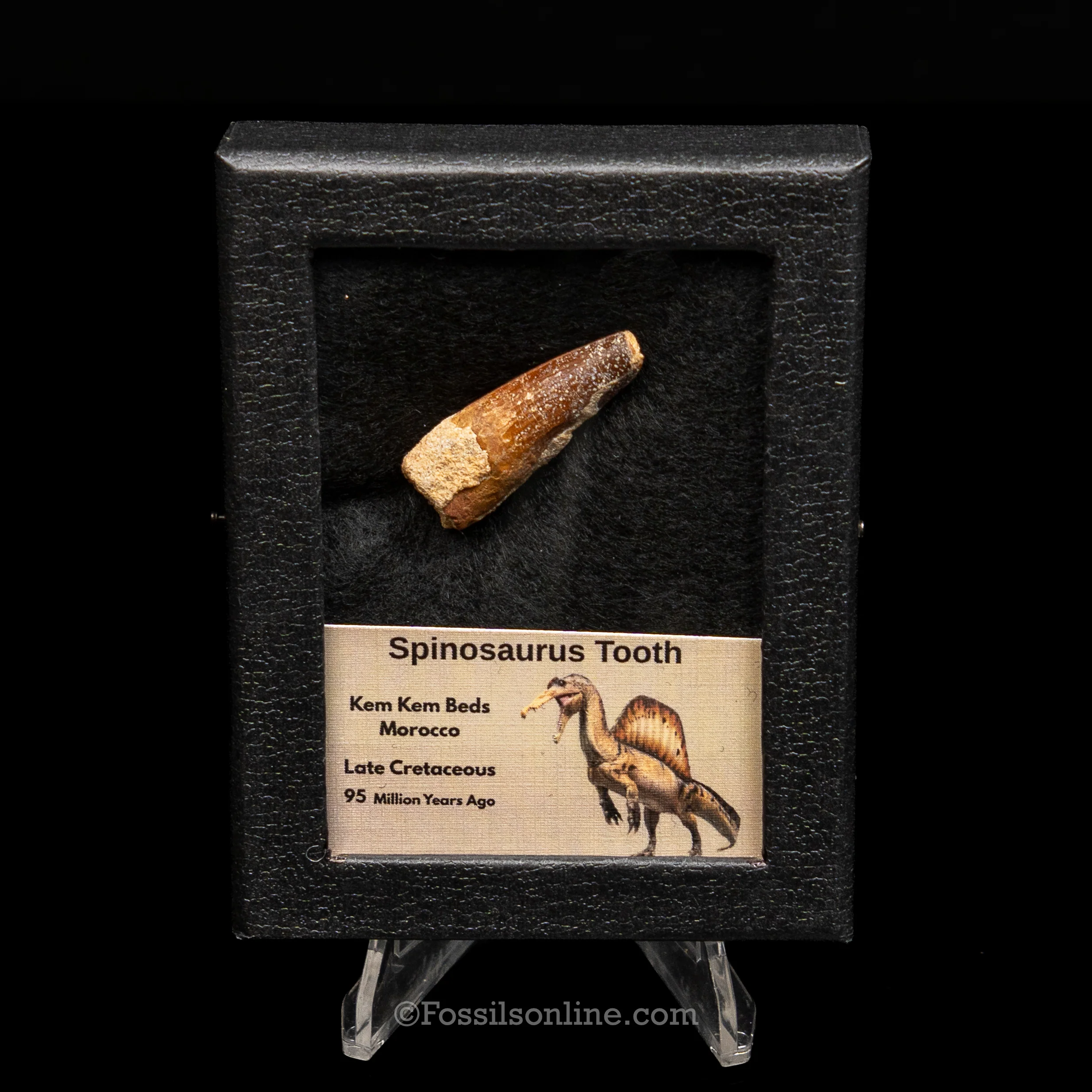
A quality Spinosaurus tooth housed in a display box measuring 4.25” x 3.25”.
Teeth measure between 1.15"-1.75"
The item shown in the picture will be provided to you.
I go through thousands of spinosaurus teeth each year and it’s rare to come across a perfect, unbroken tooth.
I’ve selected some of the choice teeth from the group—while a few may be on the smaller side, they’re in excellent condition, which is reflected in the price. None have been repaired, and each still has a thin field-applied glue coating. I’ve taken clear, close-up photos to highlight details that aren’t always visible to the naked eye.
Best bang for your buck when it comes to buying a theropod dinosaur tooth…the largest carnivorous dinosaur that ever existed.
Spinosaurus is one of the strangest and most debated dinosaurs ever found — a huge predator that stalked river systems and coastal wetlands of North Africa roughly 100–94 million years ago. With a crocodile-like snout, a tall back "sail," and a likely semi-aquatic lifestyle, it doesn't look or behave like the land-stalking predators most people picture.
A discovery lost to war First found in Egypt in 1912 and described by Ernst Stromer in 1915, the original fossils came from the Bahariya Formation. Stromer's holotype was destroyed in 1944 when a Munich museum was bombed in WWII, leaving only notes and photos — a big reason later fossils from Morocco are still debated.
Size and habitat Spinosaurus lived in river and delta systems across Morocco, Egypt, Algeria, and Tunisia, with famous finds from the Kem Kem Beds. Most estimates put it at 14–18 meters long and 7–8+ tons — likely the longest known theropod, possibly surpassing T. rex in length if not bulk.
What made it different
- Long, narrow, crocodile-like skull with conical teeth for gripping slippery prey
- A tall sail of neural spines along its back
- Shorter, more squat hind limbs than other giant theropods
- A tall, fin-like tail suited for swimming
A semi-aquatic hunter Evidence points to a life spent largely in and around water: non-serrated, fish-gripping teeth, denser bones for buoyancy control, a paddle-like tail, and an unusually high concentration of teeth in river deposits. Some researchers argue for a wading shoreline hunter rather than a fully aquatic one, but either way, Spinosaurus filled a niche no other giant theropod did.
Why its teeth are common and affordable Unlike T. rex, Spinosaurus teeth turn up in real volume:
- The Kem Kem Beds' river/delta deposits are exceptional at preserving teeth
- Its aquatic lifestyle meant shed teeth were quickly buried in water
- Like all theropods, it constantly replaced teeth over its lifetime
- The Kem Kem Beds are actively and commercially worked by local collectors
That combination makes a Spinosaurus tooth an accessible entry point into big-theropod collecting.
Spinosaurus vs. T. rex vs. Carcharodontosaurus
- Teeth: Spinosaurus's are conical and largely unserrated (built for fish); T. rex's are thick, serrated bone-crushers; Carcharodontosaurus's are blade-like slicers.
- Habitat: Spinosaurus hunted rivers and wetlands; T. rex was a terrestrial hunter/scavenger; Carcharodontosaurus hunted large land herbivores.
- Availability: T. rex teeth are extremely rare and costly, Carcharodontosaurus teeth are scarce, and Spinosaurus teeth are abundant enough to be genuinely collectible.
The sail Its purpose is still debated — display and species recognition, thermoregulation, or stability while swimming are the leading theories. Whatever it did, it makes Spinosaurus instantly recognizable.
A dinosaur still being rewritten Reconstructions have shifted dramatically: from a typical sailed theropod, to a T. rex-like stance, to today's long-bodied, short-legged, paddle-tailed semi-aquatic animal. Every new fossil out of North Africa reshapes the picture.
Why collectors love it It's one of the largest carnivorous dinosaurs ever found, has a genuinely bizarre look, stays in the spotlight of current research, and — thanks to the Kem Kem Beds — its teeth are affordable enough that most collectors can actually own one. A single tooth connects you to a giant, sail-backed predator that ruled Cretaceous rivers long before T. rex existed.

Details & Craftsmanship
Every detail has been carefully considered to bring you the perfect product.

Details & Craftsmanship
Every detail has been carefully considered to bring you the perfect product.
Details & Craftsmanship
Every detail has been carefully considered to bring you the perfect product.

Details & Craftsmanship
Every detail has been carefully considered to bring you the perfect product.

Details & Craftsmanship
Every detail has been carefully considered to bring you the perfect product.

Details & Craftsmanship
Every detail has been carefully considered to bring you the perfect product.

Details & Craftsmanship
Every detail has been carefully considered to bring you the perfect product.

Details & Craftsmanship
Every detail has been carefully considered to bring you the perfect product.

Details & Craftsmanship
Every detail has been carefully considered to bring you the perfect product.

Details & Craftsmanship
Every detail has been carefully considered to bring you the perfect product.

Details & Craftsmanship
Every detail has been carefully considered to bring you the perfect product.
Description
A quality Spinosaurus tooth housed in a display box measuring 4.25” x 3.25”.
Teeth measure between 1.15"-1.75"
The item shown in the picture will be provided to you.
I go through thousands of spinosaurus teeth each year and it’s rare to come across a perfect, unbroken tooth.
I’ve selected some of the choice teeth from the group—while a few may be on the smaller side, they’re in excellent condition, which is reflected in the price. None have been repaired, and each still has a thin field-applied glue coating. I’ve taken clear, close-up photos to highlight details that aren’t always visible to the naked eye.
Best bang for your buck when it comes to buying a theropod dinosaur tooth…the largest carnivorous dinosaur that ever existed.
Spinosaurus is one of the strangest and most debated dinosaurs ever found — a huge predator that stalked river systems and coastal wetlands of North Africa roughly 100–94 million years ago. With a crocodile-like snout, a tall back "sail," and a likely semi-aquatic lifestyle, it doesn't look or behave like the land-stalking predators most people picture.
A discovery lost to war First found in Egypt in 1912 and described by Ernst Stromer in 1915, the original fossils came from the Bahariya Formation. Stromer's holotype was destroyed in 1944 when a Munich museum was bombed in WWII, leaving only notes and photos — a big reason later fossils from Morocco are still debated.
Size and habitat Spinosaurus lived in river and delta systems across Morocco, Egypt, Algeria, and Tunisia, with famous finds from the Kem Kem Beds. Most estimates put it at 14–18 meters long and 7–8+ tons — likely the longest known theropod, possibly surpassing T. rex in length if not bulk.
What made it different
- Long, narrow, crocodile-like skull with conical teeth for gripping slippery prey
- A tall sail of neural spines along its back
- Shorter, more squat hind limbs than other giant theropods
- A tall, fin-like tail suited for swimming
A semi-aquatic hunter Evidence points to a life spent largely in and around water: non-serrated, fish-gripping teeth, denser bones for buoyancy control, a paddle-like tail, and an unusually high concentration of teeth in river deposits. Some researchers argue for a wading shoreline hunter rather than a fully aquatic one, but either way, Spinosaurus filled a niche no other giant theropod did.
Why its teeth are common and affordable Unlike T. rex, Spinosaurus teeth turn up in real volume:
- The Kem Kem Beds' river/delta deposits are exceptional at preserving teeth
- Its aquatic lifestyle meant shed teeth were quickly buried in water
- Like all theropods, it constantly replaced teeth over its lifetime
- The Kem Kem Beds are actively and commercially worked by local collectors
That combination makes a Spinosaurus tooth an accessible entry point into big-theropod collecting.
Spinosaurus vs. T. rex vs. Carcharodontosaurus
- Teeth: Spinosaurus's are conical and largely unserrated (built for fish); T. rex's are thick, serrated bone-crushers; Carcharodontosaurus's are blade-like slicers.
- Habitat: Spinosaurus hunted rivers and wetlands; T. rex was a terrestrial hunter/scavenger; Carcharodontosaurus hunted large land herbivores.
- Availability: T. rex teeth are extremely rare and costly, Carcharodontosaurus teeth are scarce, and Spinosaurus teeth are abundant enough to be genuinely collectible.
The sail Its purpose is still debated — display and species recognition, thermoregulation, or stability while swimming are the leading theories. Whatever it did, it makes Spinosaurus instantly recognizable.
A dinosaur still being rewritten Reconstructions have shifted dramatically: from a typical sailed theropod, to a T. rex-like stance, to today's long-bodied, short-legged, paddle-tailed semi-aquatic animal. Every new fossil out of North Africa reshapes the picture.
Why collectors love it It's one of the largest carnivorous dinosaurs ever found, has a genuinely bizarre look, stays in the spotlight of current research, and — thanks to the Kem Kem Beds — its teeth are affordable enough that most collectors can actually own one. A single tooth connects you to a giant, sail-backed predator that ruled Cretaceous rivers long before T. rex existed.